
Part 1 of 12: The Sleep Hygiene Series
This is the first in a 12-part series working through the sleep hygiene factors that matter most, one at a time. We’re starting with caffeine because the relationship between caffeine and sleep runs deeper than “it keeps you up.” Caffeine has a half-life of roughly five to six hours, though it varies a lot from person to person based on genetics, age, and how much you use it.
As a rough illustration, a cup of coffee at 8pm can still have a meaningful amount active in your system at 2am. For sensitive people, even a modest dose late in the day is enough to nudge natural sleep cycles off course, including in people who fall asleep quickly and don’t think caffeine is “a problem” for them. (1,5)
There are four specific ways caffeine and sleep interact over the course of a night.
1. Trouble falling asleep
Caffeine in the afternoon or evening is one of the most common reasons it takes longer than normal to fall asleep, adding roughly 8–9 minutes to sleep onset on average in controlled studies, with bigger effects at higher doses and later timing. (3,4,5)
2. Trouble staying asleep
Caffeine later in the day is also linked to “middle-of-the-night” wakefulness, waking up and struggling to fall back asleep. On average it increases time spent awake after falling asleep (about 12 minutes) and lowers overall sleep efficiency. As a stimulant it can also contribute to extra trips to the bathroom overnight, which may compound the disruption. (1,2,3,4)
3. Missing your bedtime and losing total sleep
Caffeine late in the day reduces total sleep time, roughly 35–45 minutes less across controlled studies, so you end up with less rest overall. Practically, it can also make it harder to wind down and get to bed on time in the first place. (3,4)
4. Caffeine and sleep architecture: how deep sleep gets fragmented, and why that’s separate from oxygen-driven pulse spikes
This is the effect worth spending the most time on, because it’s the one people notice least and misunderstand most.
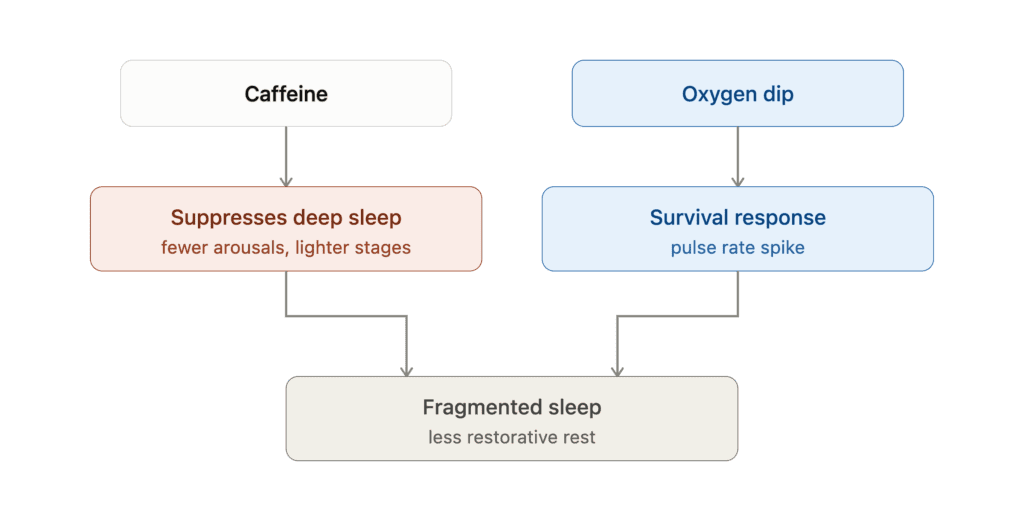
Caffeine is a stimulant that acts directly on the nervous system. Measured overnight, it tends to slightly lower heart rate on average. (6) What it actually does is blunt your drive for deep sleep: it reduces slow-wave (deep, restorative) sleep, shifts you toward lighter sleep, and increases brief arousals and awakenings. (2,3,5) That’s enough to pull you out of the deepest stages of sleep whether or not you remember waking up. (2,3,4)
This is different from another common cause of nighttime awakenings: oxygen desaturation. If you’ve ever woken with your heart pounding for no clear reason, no bad dream, no noise, nothing, your body may have been doing exactly what it’s designed to do. When oxygen levels dip too low during sleep, the body has a built-in survival response: it raises the pulse rate to move blood and oxygen through the system more quickly. It’s the nervous system correcting a low-oxygen moment in real time. That pulse spike increases oxygen delivery, but it also disrupts the night’s sleep.
If pounding-heart awakenings happen regularly, that pattern can be a sign of a breathing problem during sleep (such as sleep apnea) and is worth raising with a clinician rather than self-managing.
Two different mechanisms: caffeine suppressing deep sleep on one hand, and a survival response to low oxygen on the other, but a similar end result of fragmented, less restorative sleep. That’s part of why a single bad night can have more than one root cause operating at once.
Why timing is more precise than most people think
Here’s something we see over and over in patients going through sleep training with nightly home monitoring: one of the most important variables we identify is your ideal bedtime, the specific window where your sleep quality is measurably best. And that window is narrow. The difference between a great night and a mediocre one can come down to as little as 30 minutes in when you actually fall asleep. This clinical observation lines up with published data showing that sleep-timing mismatch and inconsistent bedtimes are independently associated with worse objective sleep. (8,9)
This is exactly why the caffeine and sleep relationship comes down to timing more than most people expect. If a stimulant is pushing your sleep onset even 10 minutes past your mark, you’ve already eaten into a third of a very tight margin. There isn’t much room for error to begin with, and caffeine quietly spends it. Protecting your bedtime window is one of the highest-yield things you can do, and keeping caffeine away from it is one of the easiest ways to protect that window.
The rule, and the biohacking caveat
he practical guideline for caffeine and sleep across all four effects is the same: give caffeine and other stimulants plenty of distance from bedtime, at least about eight to nine hours, and longer for larger doses or if you’re caffeine-sensitive. Modeling from controlled studies suggests a standard coffee (about 107 mg) needs roughly nine hours before bed to avoid measurably cutting into your sleep, and even caffeine taken six hours before bed has been shown to disrupt it. If you’re in bed by 10pm, that means aiming to finish your coffee by early afternoon. (4,7)
There’s an important caveat for the performance crowd. Biohacking strategies have popularized caffeine, especially pre-workout formulas, for performance, and there’s a real case for that during the day. But the effect on sleep can be bigger than intended. A standard pre-workout serving (around 217 mg, roughly double a cup of coffee) needs closer to 13 hours of buffer before bed, not nine, to avoid trimming your total sleep. So a late-afternoon pre-workout can still be working against you at midnight. (4) If you train in the evening, that’s a real trade-off worth planning around.
If cutting back feels harder than it sounds
Caffeine withdrawal, headaches, fatigue, low mood, and irritability, is real. It typically starts within a day of cutting back, peaks around day one or two, and eases over several days. The reason a lot of people quit trying is that they stop abruptly and get flattened. The evidence-based fix is simple: taper gradually rather than going cold turkey, which markedly reduces withdrawal symptoms while your body adjusts. (1)
The takeaway
Caffeine and sleep don’t interact as simply as “it keeps you up.” Caffeine can quietly fragment sleep you don’t even remember losing, mostly by eroding your deep, restorative stages. Give it plenty of distance from bedtime, respect that pre-workout doses need a much longer buffer, taper down instead of quitting cold, and protect the narrow bedtime window where your best sleep actually lives.
Next in the series: alcohol, and why it’s the sleep aid that isn’t. We’ll cover the nutritional aspects of coffee in the diet later on as well. For now, stick to the guidelines on timing as you deepen your commitment to sleep, and, with daily intention, to the quality of it.
Sleep is a systems issue — and it has a root cause.
At Well Rooted Health, sleep and brain function are assessed as part of the whole picture of how your nervous system and body are working. Every new patient relationship begins with a comprehensive physical exam, in Westfield NJ, New York City, or virtually.
Request an Appointment: https://wellrootedhealth.clientsecure.me
Call NJ: 908-588-7532 · NY: 212-655-5802 Email: info@gowellrooted.com
References
- van Dam RM, Hu FB, Willett WC. Coffee, Caffeine, and Health. N Engl J Med. 2020;383(4):369-378.
- Clark I, Landolt HP. Coffee, Caffeine, and Sleep: A Systematic Review of Epidemiological Studies and Randomized Controlled Trials. Sleep Med Rev. 2017;31:70-78.
- Gardiner C, Weakley J, Burke LM, et al. The Effect of Caffeine on Subsequent Sleep: A Systematic Review and Meta-Analysis. Sleep Med Rev. 2023;69:101764.
- Chang YH, Cheng YC, Cheng WJ. Age- and Dose-Specific Effects of Caffeine on Sleep: A Meta-Analysis of Controlled Crossover Trials. Sleep Med. 2025.
- Baur DM, Dornbierer DA, Landolt HP. Concentration-Effect Relationships of Plasma Caffeine on EEG Delta Power and Cardiac Autonomic Activity During Human Sleep. J Sleep Res. 2024.
- Marcus GM, Hu FB, van Dam RM, et al. Caffeine and Cardiovascular Disease: A Scientific Statement From the American Heart Association. Circulation. 2026.
- Drake C, Roehrs T, Shambroom J, Roth T. Caffeine Effects on Sleep Taken 0, 3, or 6 Hours Before Going to Bed. J Clin Sleep Med. 2013;9(11):1195-1200.
- Wongprakarnsanti K, Siritienthong J, Awirutworakul T, Sukying C, Wisajun P. Sleep-Timing Mismatch (MSFsc–Lights-Off Interval) and Its Association With Polysomnographic Sleep Parameters in a Clinical Population Under a Fixed Laboratory Schedule. Sleep Med. 2026.
- Chaput JP, Dutil C, Featherstone R, et al. Sleep Timing, Sleep Consistency, and Health in Adults: A Systematic Review. Appl Physiol Nutr Metab. 2020;45(10 Suppl 2):S232-S247.